Denied
Pinal County, Arizona
The largest data center ever proposed in the state, 3,300 acres with its own gas plants, voted down 4 to 1 in September after residents organized over water and power.
Learn
The buildings behind the AI boom, and why one may be headed for a field near you.
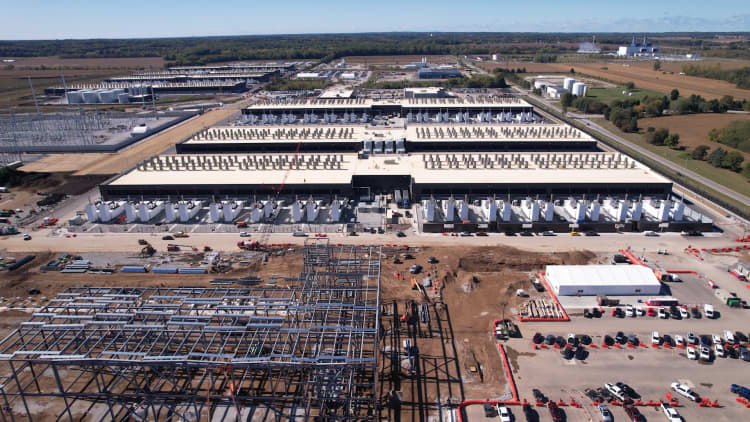
A hyperscale data center is a warehouse-scale computer: hundreds of thousands of servers in windowless buildings, running around the clock to train and serve AI models for a handful of companies. One campus can cover hundreds of acres, draw as much electricity as a mid-size city, and need millions of gallons of water a day to keep the machines from overheating.
They are being built at a pace no zoning board was designed for. The land is bought quietly, often under a code name and a non-disclosure agreement, and the power and water are spoken for before most residents hear a word. By the time a hearing shows up on the agenda, half the decision has already been made.
This site exists to close that gap: to show where these projects are landing, what they mean for the people next door, and what has actually worked to stop or reshape them.
What do they look like?
Every dot on the map is a real proposal, tracked from public filings and local reporting, with the county, the acreage, and where the vote stands.
Why you should care
A single campus can need more electricity than every home in the county combined. Utilities build new plants and lines to serve it, and the cost of that buildout is spread across everyone's bill unless state law or the utility deal says otherwise. Ask who pays for the new substation before it's built.
Cooling the machines takes water, and most of it evaporates instead of going back. In places already under drought watch or with strained aquifers, a data center becomes the largest single water user in the county overnight, competing with farms and homes for the same wells.
Cooling fans run day and night, a low hum that carries for miles over flat ground. Behind the building sit rows of diesel backup generators, dozens at a large site, that are tested regularly and run for hours when the grid falters.
Developers routinely arrive under a code name, bind local officials with non-disclosure agreements, and ask for decades of property-tax abatements in exchange for a few dozen permanent jobs. Residents usually learn the real company's name after the vote.
Farmland and residential-adjacent parcels get rezoned to heavy industrial. Once that happens, the zoning follows the land, not the project: if the first developer walks, the next one inherits the approval.
How they get approved
Options on farmland or industrial parcels, often through an LLC with no obvious owner.
A rezoning or comprehensive-plan amendment lands in the county's planning queue, weeks before it's on any agenda.
Planning commission first, then the county commission or city council. This is where public comment counts.
A handful of elected officials decide. Written opposition, delivered before the vote, is part of the permanent record.
Communities are winning
Denied
The largest data center ever proposed in the state, 3,300 acres with its own gas plants, voted down 4 to 1 in September after residents organized over water and power.
Denied
A $1.6 billion, million-square-foot campus rejected unanimously in August after months of pushback, with a countywide moratorium already in place through 2027.
Denied
A 20-story downtown data center blocked 6 to 0 after 475 opposition letters arrived and zero letters in support.
What you can do
See whether a project is filed near you and who votes on it.
Check now ↗ 02We write it for your address and county and email every commissioner, on your behalf.
Send the letter ↗ 03Heard about a filing, a hearing, or a land deal? We read every message.
Tip line ↗